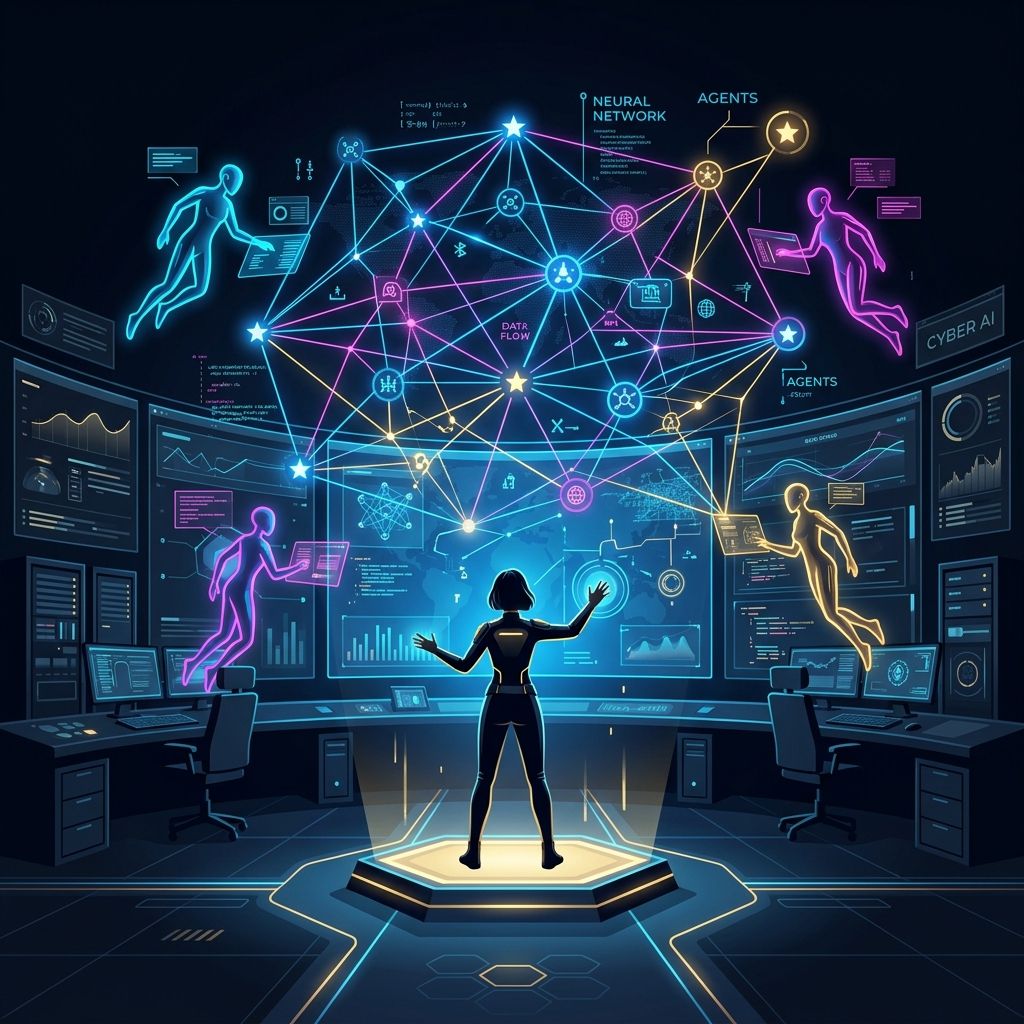
When Vibe Coding allows us to write systems just by waving our hands and speaking with our mouths, traditional development logic has been completely subverted.
How on earth should we survive in this new world completely reshaped by AI?
The Professional Shift from Vibe Coding to AI Agent Engineering
Much of the software we desperately maintain and develop today may have no reason to exist in the future.
Although Vibe Coding significantly lowers the barrier to development, allowing anyone to easily write code that runs, this only raises the lower bound of the industry.
What truly widens the professional gap, maintains software quality, and secures engineering principles is “AI Agent Engineering”.
Top engineers of the future will no longer be those who desperately grind LeetCode or memorize syntax.
The role of the top engineer of the future is more like a “Chief Director” and a “System Designer”.
Professional AI Agent Engineers need to coordinate a group of AI Agents, achieving 10x development speed while ensuring the resilience and security of the system architecture.
Why AI Capabilities Are So Uneven
It all has to do with verifiability.
In fields like Code or Math with clear right or wrong answers, AI can obtain very clear reward signals through reinforcement learning, thus progressing rapidly.
But in fields like common sense or aesthetics, the lack of clear online verification mechanisms leads to a severe disconnect in capabilities.
The AIs we summon are essentially like a group of ghosts, rather than animals evolved from nature.
The capabilities of
AI Ghostsare completely limited by “pre-trained statistical data” and “manually designed reward functions”.
Therefore, we cannot blindly trust every action of an AI Agent; human-agent collaboration remains the only safety principle at present.
Agent-Native Future Infrastructure
With the popularization of AI Agent Engineering, the future computer architecture may welcome a major reversal.
Traditional computing architecture is centered around CPU, but in the future, the Neural Network may become the main process, while the CPU is relegated to an auxiliary processor for handling deterministic tasks.
In such a world, existing software tools, frameworks, and documentation all need to be redesigned.
We need to build Agent-Native infrastructure, simplifying all documentation and APIs into sensors and actuators that AI Agents can directly read and execute.
Let AI Agents be able to go all the way from development, testing, to global deployment directly based on your prompts.
Redefining Hiring and Engineering Capabilities
Faced with such a future, corporate standards for hiring talent should also completely change.
Instead of testing boring algorithm riddles on a whiteboard, it is better to observe how candidates
guide AI Agents to build large and complex projects.
For example, you could ask the candidate to write a Twitter clone with AI within a limited time, and then send ten red-team AI Agents to try to hack it.
Whoever designs a system that can withstand the fierce attacks of AI is the truly qualified AI Agent Engineer.
This no longer tests typing speed, but architectural design capabilities and security prevention thinking.
Intelligence Becomes Cheap, What Should Humans Do?
Since intelligence has become so cheap and easy to obtain, what is the value of us human engineers?
Andrej Karpathy confessed that he now cannot even remember many of the trivial API parameter details in PyTorch or NumPy, because these tedious tasks have long been fully handed over to AI Agents.
But this definitely does not mean we can completely empty our minds.
If you completely do not understand the underlying memory structure, you cannot correctly judge whether the code written by the AI is wildly wasting computing resources.
Understanding and Taste That Cannot Be Outsourced
In the AI era, the role of humans has completely upgraded from hands-on typists to chief directors and conductors.
You must be responsible for reviewing specifications, guarding aesthetic standards, formulating architectural designs, and ensuring system consistency.
When seeing AI write code that runs, but is actually filled with copy-paste, extremely bloated and difficult to maintain, excellent engineers will still have a “heart attack.”
You can outsource your thinking process, but you absolutely cannot outsource your understanding.
Only those who truly understand the underlying logic can steer these powerful but random AI Ghosts.
When AI saves us the time of typing and memorizing syntax, what we should really invest in is our understanding of underlying principles and our taste for products.
Let us let go of our reliance on the tedious details of old-fashioned coding, and instead cultivate our ability to guard software architecture and overall design, and become system directors of the new era!