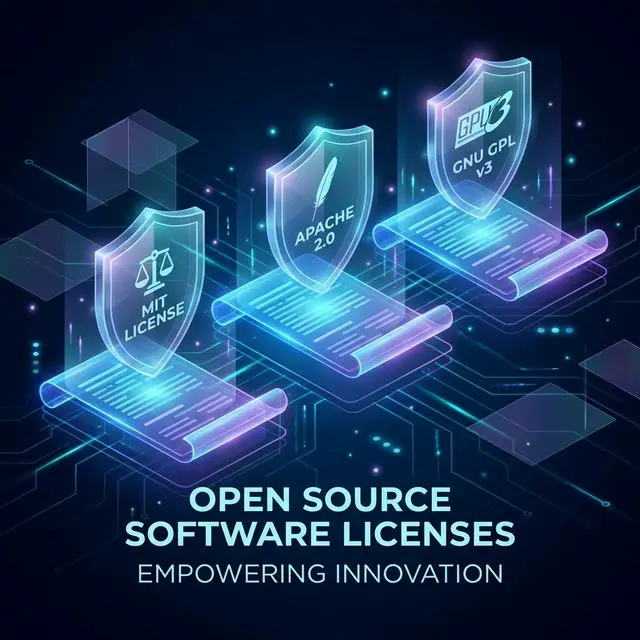
Feeling overwhelmed by a bunch of license acronyms when trying to use open-source packages from GitHub to speed up development during Vibe Coding?
If you accidentally mix “infectious” code into your company’s commercial project, the legal department might invite you for a coffee tomorrow.
A Plain English Analogy of Major Open Source Licenses
1. MIT and ISC: The Stir-Fry Stall Owner’s Favorite
These two licenses can be considered the most easygoing representatives.
Simply put, you can use them, modify them, and even turn them into commercial software to sell for money. All you have to do is keep the original author’s name or copyright notice.
| Item | Description |
|---|---|
| Representative Software | React and Vue.js both use this type of license. |
| The Difference with ISC | Essentially, ISC is a minimalist version of MIT, with shorter and simpler terms, very popular among npm tools. |
If you want to develop a package, spread it quickly, and let everyone use it, choose these two!
2. Apache 2.0: The Chain Store with Patent Protection
This license is also very permissive, similar to MIT, but it has something very powerful: a patent protection umbrella.
Big companies love this! It explicitly specifies patent licensing, meaning if you use my open-source code, you automatically get a license for the relevant patents, and you can’t just sue me over patent issues.
| Item | Description |
|---|---|
| Representative Software | Large projects like TensorFlow and Kubernetes. |
If your project is relatively complex and you want to avoid future patent disputes, Apache 2.0 is a very commercial-friendly and safe choice.
3. GPL: The Principled Missionary
Pay attention here! GPL has a frightening “infectiousness”!
If your project uses a GPL package and you “release” your software to the outside world, then your entire project must also be open-source, and this includes your core code.
| Item | Description |
|---|---|
| Representative Software | Linux Kernel |
When developing a closed-source commercial product, you must absolutely avoid GPL! Otherwise, all your commercial secrets will have to be made public.
4. LGPL and AGPL: Variants for Special Scenarios
These two are relatives of GPL, applicable to different situations:
| Item | Short Intro | Description |
|---|---|---|
| LGPL | Compromise version for underlying components | This is usually used for underlying Libraries. As long as you call it via “Dynamic Link,” your main program won’t be infected and can remain closed-source. However, if you modify the Library itself, the modified parts must still be open-source. |
| AGPL | Specialized version for cloud services | This is specifically designed for cloud SaaS services. In the past, some companies would exploit the GPL loophole, saying, “I didn’t ‘release’ the software, I just put it on a server to provide a service.” AGPL closed this gap: as long as you provide a service over the network, it counts as usage, and you must open-source it! |
Dealing with Infectious Licenses in Commercial Projects
“What if I absolutely must use something that is GPL; what should the commercial project do?”
This is when you should utilize the wisdom of software engineers and architects:
Physical Isolation Method
You can wrap the infectious open-source package into an independent “Microservice” or a Sidecar container.
Make sure your main program is not directly compiled together with it (i.e., NO Static Link), but only communicates with it via API or network protocols.
By doing this, you can effectively build a “legal firewall” to protect your core commercial secrets from being infected.
A Guide to Avoiding Pitfalls in Development
In today’s world of Vibe Coding and AI-generated code flying everywhere, our speed of writing code has increased, but the risk of accidentally mixing in toxic licenses has also skyrocketed.
It is highly recommended that in the CI/CD process, you absolutely must establish a software license scanning mechanism to avoid incorporating licenses that cannot protect commercial secrets during deployment.
Let me also remind you of one very important thing: never randomly delete the LICENSE file in an open-source project!
License Usage Scenario Decisions
| Scenario | Recommended Choice |
|---|---|
| Personal development, aiming for rapid spread of influence | MIT or ISC |
| Enterprise project, seeking stability to avoid patent disputes | Apache 2.0 |
| Developing a closed-source commercial product | Run away when you see GPL |
Choose the right license, and you can write code with peace of mind and make money confidently!