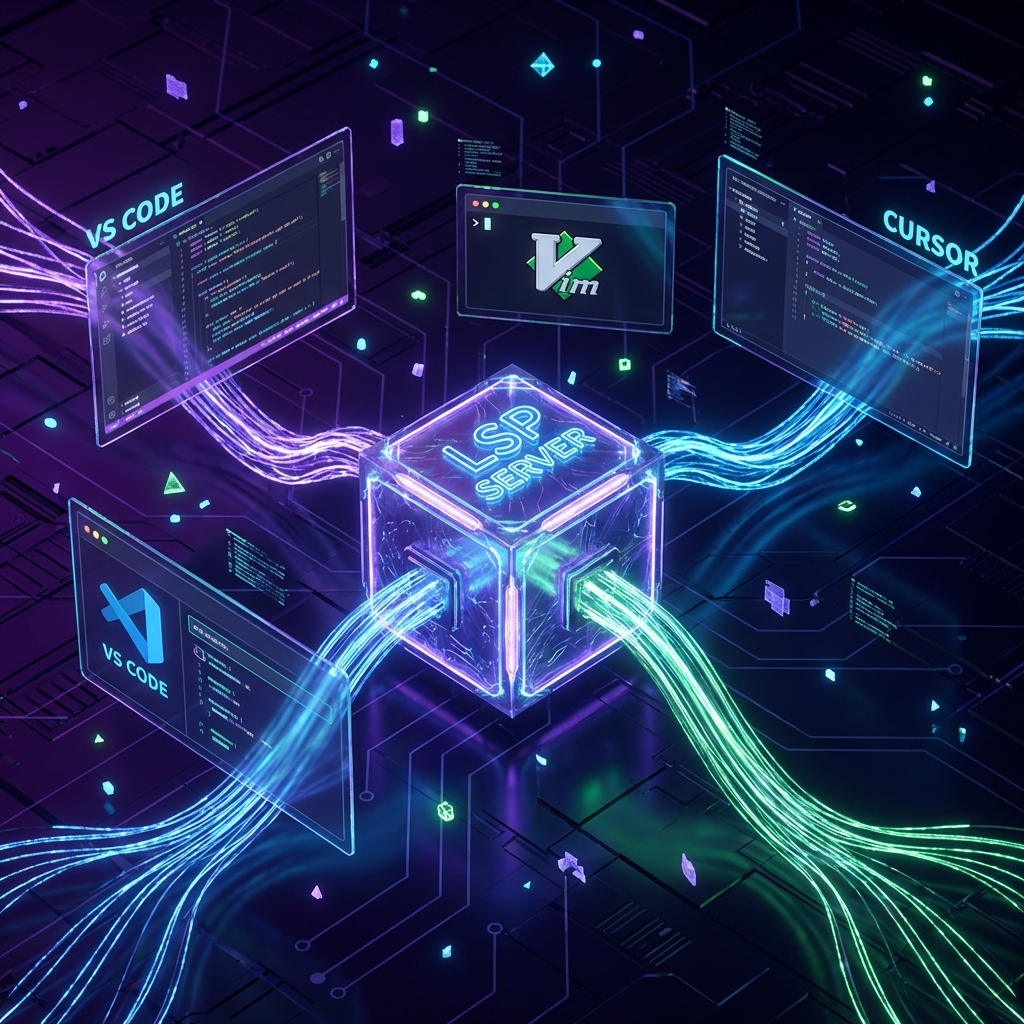
Have you ever had this experience: you just switched from VS Code to Cursor, and changing the environment felt like changing your brain, having to re-adapt to various syntax prompts? Or when you’re trying out the latest AI coding tools, you feel that while the AI is powerful, it lacks that “development rhythm”?
In fact, hidden behind all this is a mysterious hero that has unified modern development environments —— LSP (Language Server Protocol).
Imagine: A Translator and Kitchens of Different Countries 👨🍳
In the past, when we coded, changing an IDE (like switching from Eclipse to VS Code) was like moving from a Chinese kitchen to a French one. The sous-chef (syntax prompts) in the Chinese kitchen only understood Chinese, and the one in the French kitchen only understood French. If you wanted to cook braised pork in a French kitchen, you’d have to re-teach that sous-chef how to recognize soy sauce.
This was the traditional approach: every editor had to build a dedicated “brain” for every programming language. This was an enormous burden for both developers and tool creators.
LSP (Language Server Protocol) was born to solve this problem as a “Universal Translation Protocol.”
Imagine that now, all kitchens (editors) no longer maintain their own sous-chefs. Instead, they call a “Central Consultation Center” (Language Server):
- When you type
user.in VS Code, VS Code sends a message to the center: “Hey, this is a User object, what can follow it?” - The consultation center checks the data and replies: “Oh! It can be followed by
.getName()or.getEmail().”
Whether you’re using VS Code, Vim, or the currently hottest AI editor Cursor, as long as everyone speaks the “same set of phone terminology” (LSP), all editors can instantly become super smart.
The Mechanism of LSP: A Distributed Architecture for the Editor World
As a technical professional, you’ve likely handled many microservice API integrations. In fact, LSP is like a distributed architecture for the editor world, completely decoupling the “display interface” from “syntax analysis”:
| Component | Role | Description |
|---|---|---|
| Client (Frontend) | Editor / IDE | Responsible for displaying the screen, receiving keyboard events, and handling the user interface. |
| Server (Backend) | Language Server | Responsible for syntax analysis, logical operations, and type checking. |
| Communication Bridge | JSON-RPC | A standard communication protocol that allows both parties to talk to each other. |
This architecture makes maintaining development tools exceptionally simple. Previously, if there were $M$ editors and $N$ languages, $M \times N$ implementations were needed; now, you only need to write one Server for each language to support thousands of Clients.
For Vibe Coding, What is LSP? 🎸
Amidst the trend of Vibe Coding (coding by feel), we pursue the flow of inspiration. You might be telling the AI: “Help me write an API for processing orders, with validation functionality.”
At this moment, LSP’s role is more like a professional “Camera Assistant”:
- Real-time Error Correction (Red Squiggly Lines): When AI helps you generate code, LSP immediately catches syntax errors in the background. It’s like when you’re directing a scene (Vibe Coding); even though you only care about the overall “feel,” LSP will remind you: “Director, this lamp (variable) isn’t plugged in!”
- Go to Definition: When you “feel” a function is behaving strangely, one click takes you there. This allows you to fly between different files quickly, maintaining your development rhythm without having to manually search the directory tree for ages.
Conclusion: Let Development No Longer be at the Mercy of Tools
Simply put, LSP is the “Grand Unified Theory” of the development tool world. It frees developers from being hijacked by a single tool and makes AI-assisted development more stable and rhythmic.
Next time you switch to a new tool and see that familiar red squiggly line or precise syntax completion, don’t forget to thank this Universal Translator working silently in the background!